Streamer YouTube operation method: Structure to create long forms and shorts in one broadcast
What streamers lack is not the content, but the structure to use the content. From the criteria for dividing a broadcast into long form, shorts, and clips, to the weekly operating rhythm, and the division of roles between shorts and long form, it has been organized in a repeatable format.

ClipSpray Team
 ClipSpray
Key takeaways
- What streamers lack is not content, but a structure to use content that has already been created. If you broadcast 4 times a week for 5 hours, you will accumulate 20 hours of original content every week.
- If you watch YouTube as a second broadcast, it won't last long. We need to change the structure to distributing the live version as the original and long form, shorts, and clips.
- The first thing to decide is not the number of uploads, but the amount that can be repeated each week. It is better to accumulate several months rather than one week.
- Shorts are not an abbreviated version of the broadcast, but rather an entrance that introduces the streamer to first-time viewers. The situation must be established in the first two seconds.
- Long form is not a summary of today's broadcast, but focuses on one of the biggest events. If you separate the remaining small incidents into shorts, the two will not compete.
They broadcast every day, but there have been no videos on YouTube for a month. It may seem strange, but it's a common situation for streamers.
It's not because there's no content. On the contrary, there is too much content. If you broadcast 4 times a week for 5 hours a day, you will have 20 hours of video a week. The problem is that you have to find 10 minutes and 30 seconds of shorts to add out of those 20 hours.
That's why many streamers keep putting it off, thinking that they should also do YouTube. This is because they see YouTube as a new production business. The most realistic way to operate YouTube as a streamer is not to create a separate video, but to rewrite an already broadcast with multiple contents.
For streamers, YouTube is not the second broadcast
When you think about starting YouTube, it suddenly seems like there is a lot to do. You have to plan, shoot, edit, create thumbnails, and upload shorts. If you look at it this way, it's difficult to do it consistently while broadcasting.
The structure needs to change.
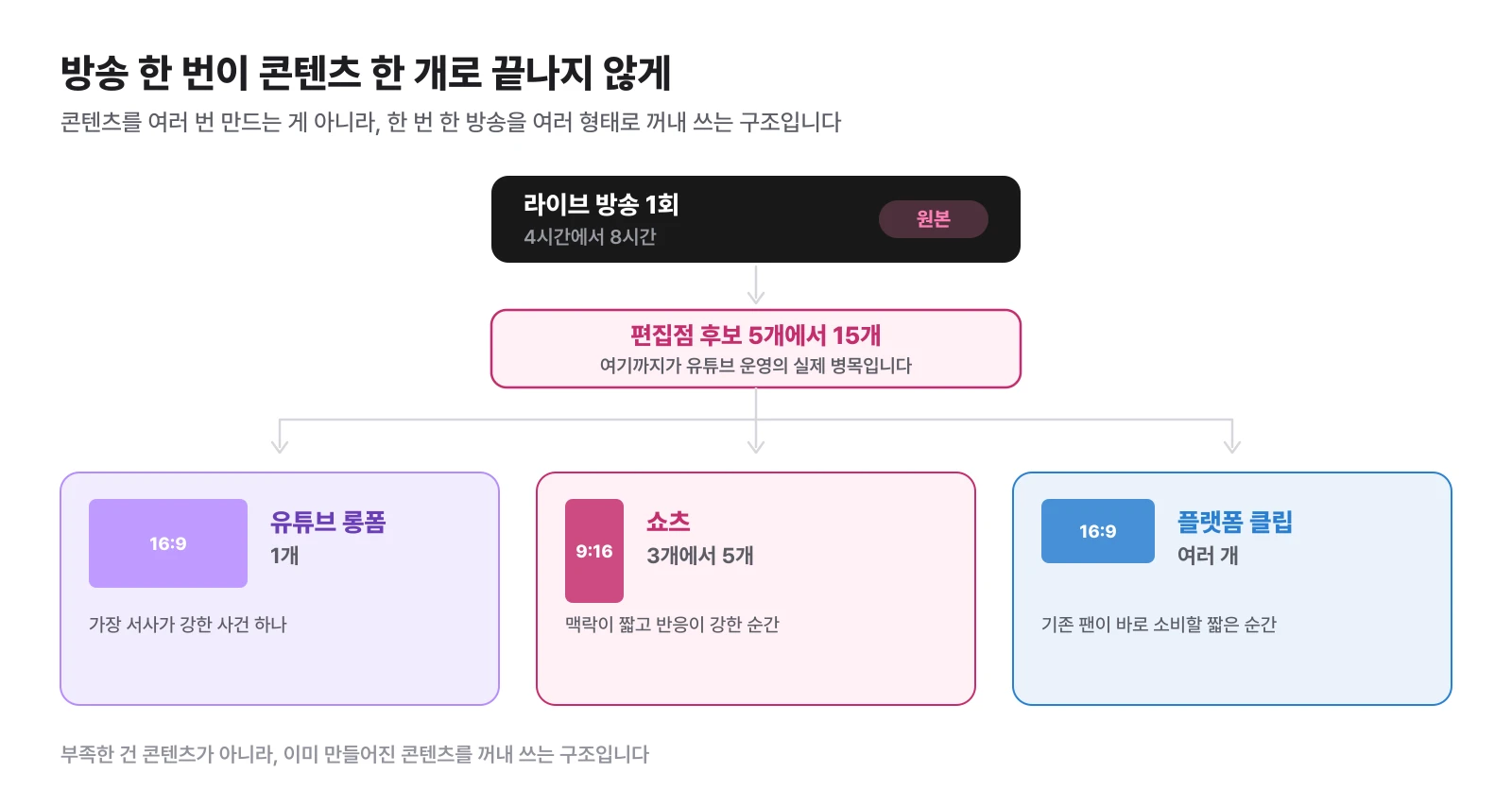
You’re not creating content four times. One broadcast is distributed in four ways.
- Live Broadcast: Original content. This is where it all comes from.
- YouTube Long Form: A narrative summary of one of the best events.
- Shorts: Condensed only the strongest moments.
- Platform Clips: Short moments that your existing fans will consume right away.
Understanding this difference greatly reduces operational difficulty.
How much content will be shown in one broadcast?
Let’s say you broadcast a game for 6 hours. Something like this happened on TV.
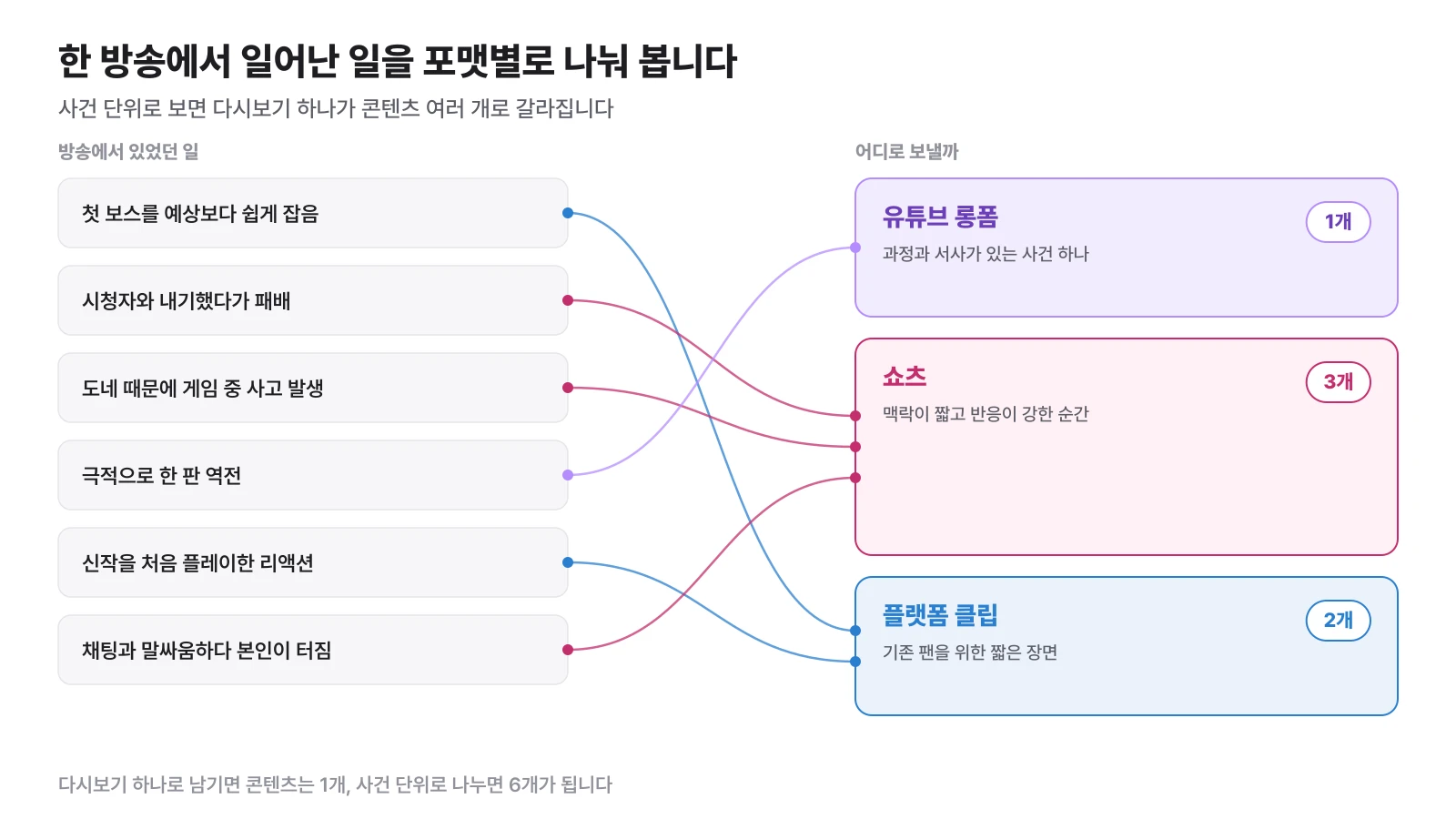
| What happened on air | where | Reason |
|---|---|---|
| A dramatic turnaround | long form | The process is long and there is a narrative |
| Bet with viewers and lost | Shorts | The situation is explained in one line |
| Accident occurred during game due to sponsorship | Shorts | Events and reactions are briefly attached |
| I exploded while chatting and arguing | Shorts | The reaction itself is content |
| Defeating the first boss was easier than expected | clip | It only makes sense for existing fans |
| Reaction from playing the new game for the first time | clip | It is short and lightly consumed |
If you leave this as just one replay, there will be only one piece of content. If you look at the incident unit, there are 6.
The key to running a YouTube streamer is not creating more content, but not missing content that has already been created.
The first thing to decide is not the number of uploads
How many shorts should I wear per day, and how many long forms should I wear per week? If you start with this question, it will be difficult to last long.
The first thing to check is how much you can make repeatedly each week.
If you broadcast 5 times a week and decide to create one long form for each broadcast, the backlog of editing will pile up in just a week. In the beginning, it is better to keep it to this level rather than increasing it excessively.
| Getting Started | After getting used to it | |
|---|---|---|
| Shorts | 3 to 5 states | 5 or more states |
| long form | 1 state | 1 to 2 states |
| clip | As it happens during the broadcast | As is |
The important thing is not to work hard one week, but to build up over several months. If you can afford it, you can increase it.
Leave a comment within 30 minutes after the broadcast ends
One of the best ways to make operations easier is to organize your broadcast material while it is still alive. Leaving these three things right after broadcast will greatly reduce your work the next day.
- 1 to 3 funniest scenes of the day, including timecode if possible
- The scene where Chat reacted loudly, not me.
- An event described in one sentence, for example, “I did what the viewer told me to do and lost 3 hours.”
The third is especially important. “Playing games today” does not become a title, but an event described in one sentence becomes a title.
The problem is that I don't remember most of it
This is difficult to maintain during broadcast. When I play games, watch chat, read sponsorships, and think about the next content, I think, “I just saw that on YouTube,” and then forget about it 20 minutes later. When the broadcast ends, I don't even remember what time it came out.
Therefore, streamer YouTube operations require a structure that does not rely on memory for content discovery. There are many ways to do this, whether you're marking the broadcast yourself, having an editor time-stamp it in real time, checking your chat and sponsorship history later, or using a tool that analyzes the entire broadcast.
Whatever you write, the goal is the same. It should be “Good scenes are automatically shortlisted”, not “I edit if I remember”**.
Shorts start based on the first person you see
A shortened replay of the show as is could be fun for existing fans. But a first-time viewer doesn't know the internal meme, the content of yesterday's broadcast, or the streamer's character.
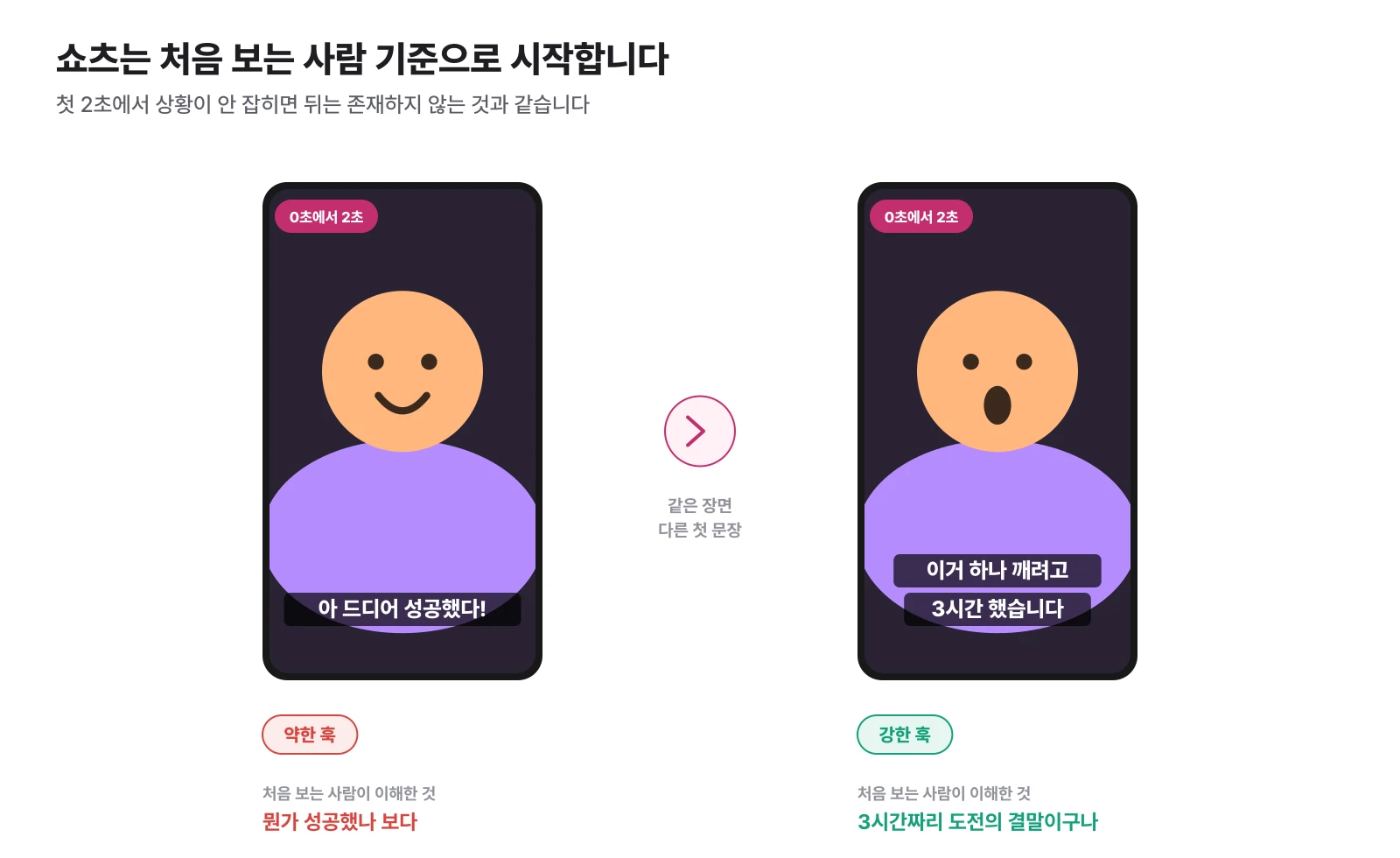
If you start with “Ah, I finally succeeded!”, it only conveys that something was successful. On the other hand, if you start with “I spent 3 hours trying to beat this,” it conveys the conclusion of a 3-hour challenge all at once. It's the same scene, but the amount of information changes with just the first sentence.
Another way is to show the results first and keep the process short. It's best to think of shorts as a gateway to introduce new people to the streamer, rather than an abridged version of the stream.
Vertical screen placement and subtitle processing are summarized with screen examples in Creating Chzzk Shorts.
Long form is not a summary of today’s broadcast
There is one common mistake. All the fun things that happened during the 6-hour broadcast are put into one video.
Then the title becomes ambiguous. “Broadcast highlights from ○ month ○ day” can be viewed by existing fans, but for first-time viewers, there is little reason to click on it.
Instead, focus on one big event. If the boss battle was the strongest, it becomes a story, such as "I challenged a boss that people said I could never beat." Other small incidents are boldly separated into shorts.
This way the longforms and shorts don't compete with each other. Because each person has a role.
Shorts and long forms are not mutually exclusive.
If you wear a lot of shorts, wouldn't you be able to see the long form less? This is a concern that comes up often, but it can be resolved by taking on different roles.
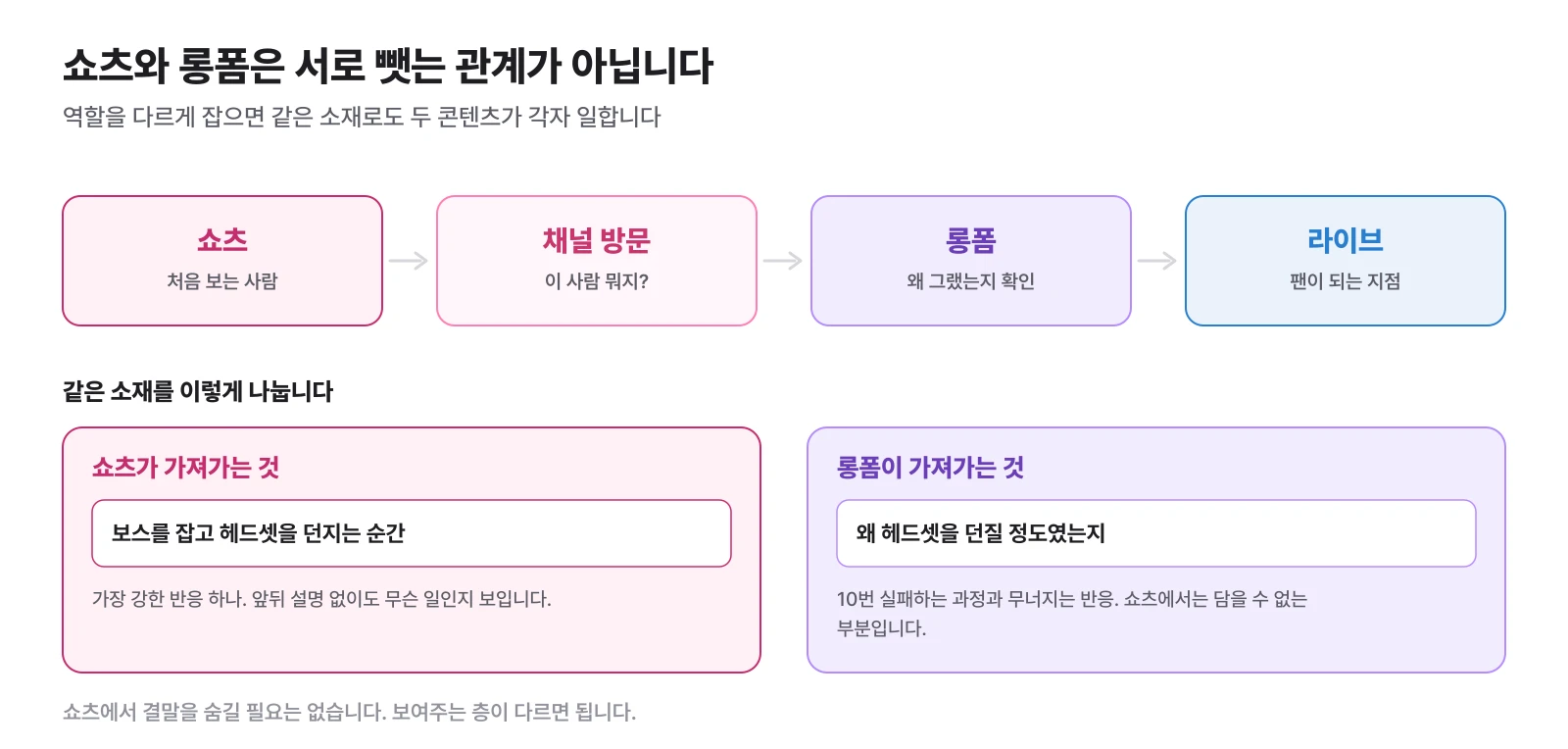
This doesn't mean you have to hide the ending in the shorts. You can change the layers shown. In the short form, they showed the moment when they grabbed the boss and threw the headset, but in the long form, they showed why it was so difficult to throw the headset. Even if the material is the same, the purpose of viewing varies.
If you run it alone, group it by day of the week.
You don’t have to do everything in one day. Grouping the same kind of work together makes it easier to manage than opening and closing an editing program every day.
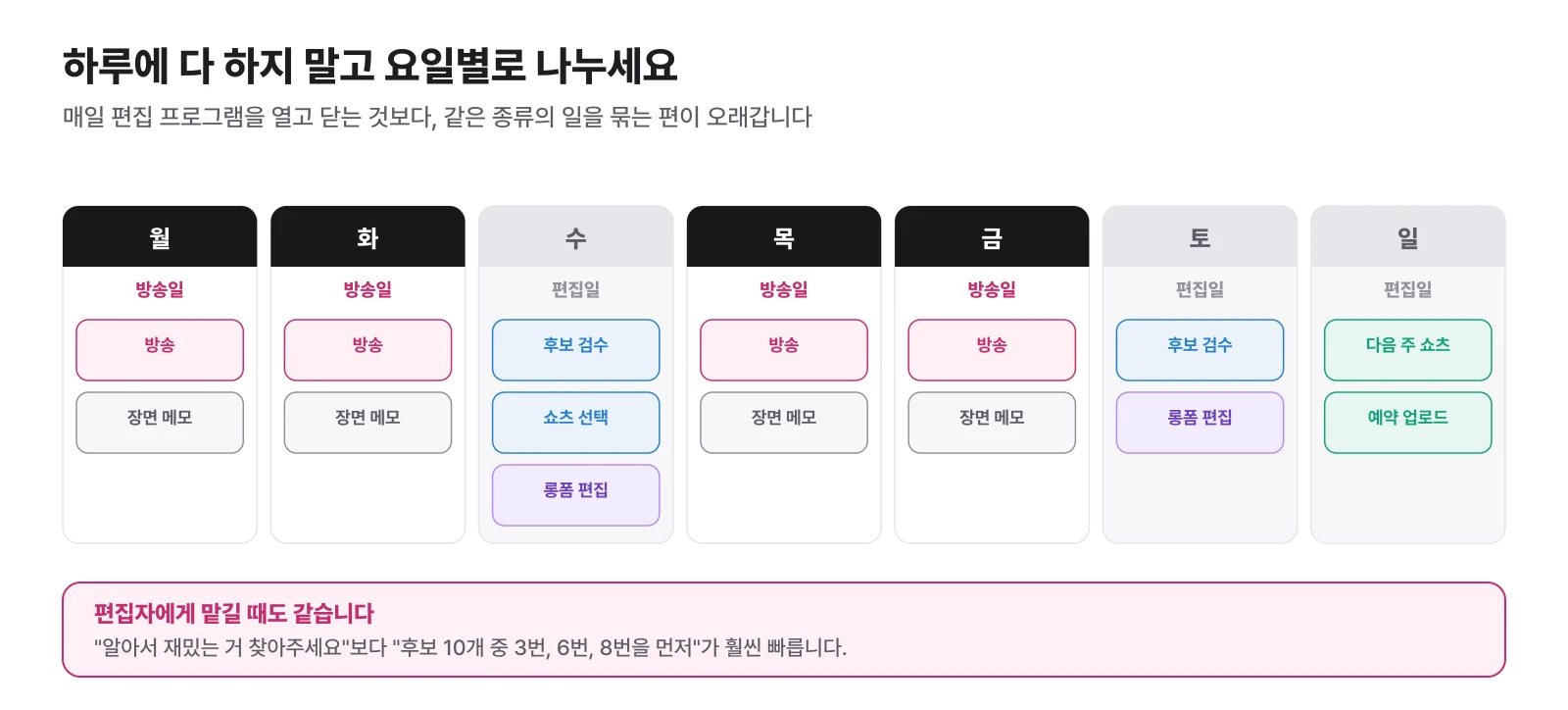
The same applies when using an editor. Rather than saying, “Please find something interesting on your own,” the editor will work much faster if you can say, “There are 10 candidates for this broadcast, and among them, please edit numbers 3, 6, and 8 first.”
How to organize the work order itself was covered in detail in How to Edit Game Broadcasts], up to the rough cut stage.
If automated, start from the beginning before the subtitles.
When you think of video AI, it's easy to think of automatic subtitles. Of course it helps. But the bigger problem for streamers is long originals.
Rather than spending hours looking for a 30-second scene in a 6-hour broadcast and then creating subtitles 10 minutes earlier, it is more effective to reduce the video itself to watch first.
ClipSpray was built around this point. Chzzk and SOOP This method analyzes the entire broadcast to create timelines and editing point candidates, which then lead to cut editing, subtitles, and short form production. The goal is not to have AI decide all content for the streamer, but to reduce the time spent choosing what to watch out of the six hours. The final choice must be made by a person.
In the end, it's not a content production problem
If you're already broadcasting, dozens of hours of content are being produced every week. What is lacking is not the content, but the structure of extracting and using the content.
When the broadcast ends with a replay, the content is buried as is. If you connect from broadcast to editing point, long form, shorts, and clips, the same broadcast works multiple times.
So, if you are a streamer looking to start a YouTube channel, ask this first before thinking about what to create.
How much content was already created in this week's broadcast?
If there are few answers, it is quicker to rewrite an existing broadcast than to create a new project. Instead of broadcasting more, start by writing more of the broadcasts you already do.
You can find out where and at what length you will upload the results in The shorts I made, where should I post them to get the number of views? ], and the replay storage period and backup settings can be found in Chzzk replay summary .
Frequently Asked Questions
Is it better for streamers to also run YouTube?
Live platforms and YouTube have different ways of consuming content, so if you recycle existing broadcasts into long forms and shorts, you can expose it to people who have not watched the broadcast. However, rather than setting an unreasonable upload schedule from the beginning, it is better to start with a frequency that can be maintained for several months.
What kind of videos should I upload to Streamer YouTube?
It is efficient to divide the main events of a long broadcast into long forms, short context and strong reaction moments into shorts, and short scenes that are interesting to existing fans into platform clips. Editing goes faster if you decide which format to send an event to.
Can I make multiple shorts in one broadcast?
It is possible. Since there are multiple events and reactions in one broadcast, it can be divided into several shorts if each scene is understood independently. This is different from uploading the same scene multiple times, just changing the length.
Is it possible to run YouTube without an editor?
It is possible. In the beginning, you can operate with a focus on shorts, or you can operate it yourself by reducing repetitive tasks such as automatic subtitles and editing point navigation with tools. As the channel grows, the order in which you add editors is safer.
Can I find YouTube material without checking all the broadcast replays?
You can first narrow down the section to check by using markers, chat volume changes, sponsorship records, and voice changes during the broadcast. Another way is to use a tool that analyzes the entire broadcast and creates candidate edit points.
If you wear a lot of shorts, won't you look at the long form?
If you take on different roles, they won't take away from each other. In shorts, the streamer's character and the strongest moments are shown, and in long form, the process of why that happened is shown, which changes the purpose of watching.
Source
Don't miss the moment when my broadcast explodes.
Just enter a replay link and the chat and sponsorship responses will be analyzed to create scenes to be made into shorts. I'll find it for you.
Try it for free with my stream10 vouchers upon signing up · No card registration
Share this post
read together
Creating a reel from a 3-hour broadcast: How to choose 15 seconds to write and move them vertically
2026-08-31 · About 12 min
How to find 30 seconds in a 6-hour broadcast and reduce streamer reel editing time
2026-08-31 · About 10 min
Reasons why editor recruitment is inconsistent, from division of work to unit price and settlement
2026-08-31 · About 12 min